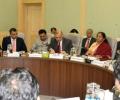
At a pre-Budget meeting, the FM was asked to ensure that NBFCs come out of the liquidity crisis they are facing with the help of RBI. They also spoke about the futility of trying to achieve a 3 per cent fiscal deficit target over the medium term.

Even with the possible expenditure roll-overs and off-budget financing, the fiscal deficit target will not be met. The FRBM Act, after its amendment in 2018, allows a fiscal deficit slippage of not more than 0.5 per cent for any given year, provided there are justifications. These justifications include war, national security, severe collapse in the agriculture sector, a major natural calamity, big structural economic reforms, or the decline in real output growth of a quarter by at least 3 percentage points below its average of the previous four quarters.
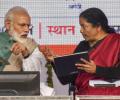
In the 2020-21 Budget, the prime minister and the finance minister are keen to stamp their narrative, after various rollbacks following the previous Budget, said top government sources. Besides the scheduled meetings, the sources said, the Prime Minister's Office is expected to hold several meetings with top secretaries and officials on various ongoing schemes, their performance and also how some of them could be tweaked for better results.

Banks will also consider requests from MSMEs for restructuring their stressed standard assets. So far, only 25 per cent of the around 1 million eligible MSMEs have taken benefit of the RBI's special dispensation.

Gig workers are usually spoken of in the context of the sharing economy, like Uber, Ola drivers, delivery persons for Zomato and Swiggy and so on. This is the first time such workers will be covered under India's social security law.
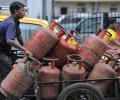
Only 48.3 per cent of the rural households used LPG, while the figures were much higher in urban areas at 86.6 per cent, according to a NSO report.

Long-term capital gains tax may be scrapped and the burden of dividend distribution tax could perhaps be shifted from companies to shareholders. Also, the Budget could provide income tax relief for the salaried classes, while proposing tax sops for small, medium and micro enterprises.
The government's decision to release the reports comes two days after over 200 scholars from across the globe issued a statement demanding release of all withheld reports produced by the NSO, including the household consumer expenditure survey that was junked.

Experts said a dip in consumption expenditure indicated an increasing prevalence of poverty in the country.

Sitharaman said the Bill has proposed giving a legal framework for fixed-term employment through which contract workers serving a fixed-tenure will get equal statutory social security benefits as regular workers in the same unit.

The findings of the report showed consumer spending falling for the first time in over four decades in 2017-18. The government has, however, termed it a "draft" report, reports Somesh Jha.

Sources said the rural development ministry has sought an additional Rs 20,000 crore for MGNREGA for 2019-20 over and above the budgeted Rs 60,000 crore for 2019-20. Though, all of the PM-KISAN savings may not be transferred to fund MNGREGA's extra needs, sources said a part of this could be transferred.

In the draft rules, among 681 listed professions, armed security guards, supervisors, surveyors, and carpenters (class I) are proposed to be treated as highly skilled professionals; electricians, tailors and drivers are skilled; cooks and cobblers as semi-skilled and dairy coolies, office peons and sweepers as unskilled.
After taking benefit of the scheme, jobs increased by around 11 mn in establishments that took loans.

'We expect a pick-up in the second half of the current fiscal. But before that, data is likely to show a further slowdown. The second quarter print is likely to be worse than the first quarter,' said a senior official.

The economy could grow at 6-6.5 per cent this fiscal year (2019-20 or FY20), said Chief Economic Advisor Krishnamurthy Subramanian, revising his earlier estimate of 7 per cent in the Economic Survey. In an interaction with Arup Roychoudhury, he said supply-side measures, including corporation tax cuts, will boost consumption and demand, and non-tax revenue may make up for shortfall in tax revenues.
Dissatisfaction with the state leadership, along with caste and sectarian factors and economic issues -- particularly those relating to jobs and rural distress cost the BJP.

Part of the dues has been pending since 1995-96 - the inception year of the Employees' Pension Scheme administered by the EPFO. The Centre also owes the EPFO more than Rs 1,000 crore towards the minimum pension scheme it had notified in September 2014.

The government would be ironing out issues related to the controversial 'bail-in' clause in the earlier Bill, explore hiking the deposit insurance cover of customers, and decide whether the resolution framework should apply to public sector banks.

PSBs have been requested to reach out to MSMEs to provide bill discounting to them against their dues since they suffer the most from shortage of cash.
 © 2025 Rediff.com - Investor Information - Advertise with us - Disclaimer - Privacy Policy - Sitemap - Feedback - About us - Terms of use - Grievances